(02) The Context
The problem
- Internal teams needed a single place to monitor activity across the wider payment ecosystem.
- The admin platform brought together many distinct operational areas — merchants, users and roles, MDA accounts, transactions, settlements, reconciliations, tickets, audit logs and reports — that all needed to live in one coherent interface.
- Large amounts of operational information had to be presented clearly rather than overwhelming administrators.
- Alaje integrates with backend and third-party services, so integration timelines occasionally affected the overall development process.
(03) My Role
My contribution
- Converted product designs into functional interfaces
- Built the frontend application in React
- Created reusable and maintainable UI components
- Implemented responsive user interfaces
- Integrated frontend features with backend APIs
- Integrated with external and third-party APIs where required
- Tested features extensively to ensure they worked as expected
(05) The Engineering
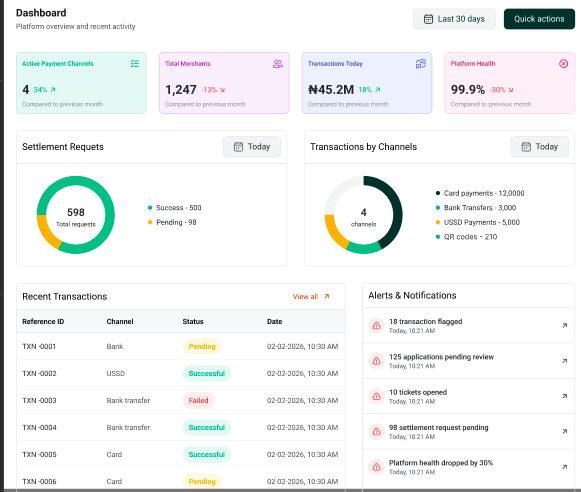
The Admin platform was built by converting the provided designs into reusable React components and application pages — dashboard layouts, navigation, data displays, tables, forms and status indicators. Once the interfaces were in place, I integrated them with the backend services powering the platform. Because some features depended on external and third-party services, development required continuous testing and coordination to confirm each feature worked correctly once its required integration became available.
(06) The Product
What it does
(07) Challenges & Decisions
The challenge
Because this was a payment-related product spanning many operational areas, data displayed in the admin dashboard needed to be accurate and reliably kept in sync with backend and third-party services.
The decision
I tested features repeatedly to confirm that data was displayed correctly, that API integrations behaved as expected, and that transaction and operational information was accurately reflected in the interface.
(08) Results
Impact
- Functional frontend implementation delivered for the Alaje Admin platform
- Centralised dashboard covering payment channels, merchants, users, MDA accounts, transactions, settlements, reconciliations, tickets, audit logs, reports and platform configuration
- Admin frontend integrated with the backend and third-party services powering the platform
(09) What I Learned
Building the interface was only one part of delivering a working product — dependencies on backend and third-party services could significantly influence timelines. That reinforced the need for continuous testing and coordination so features worked correctly once the required integrations became available.